
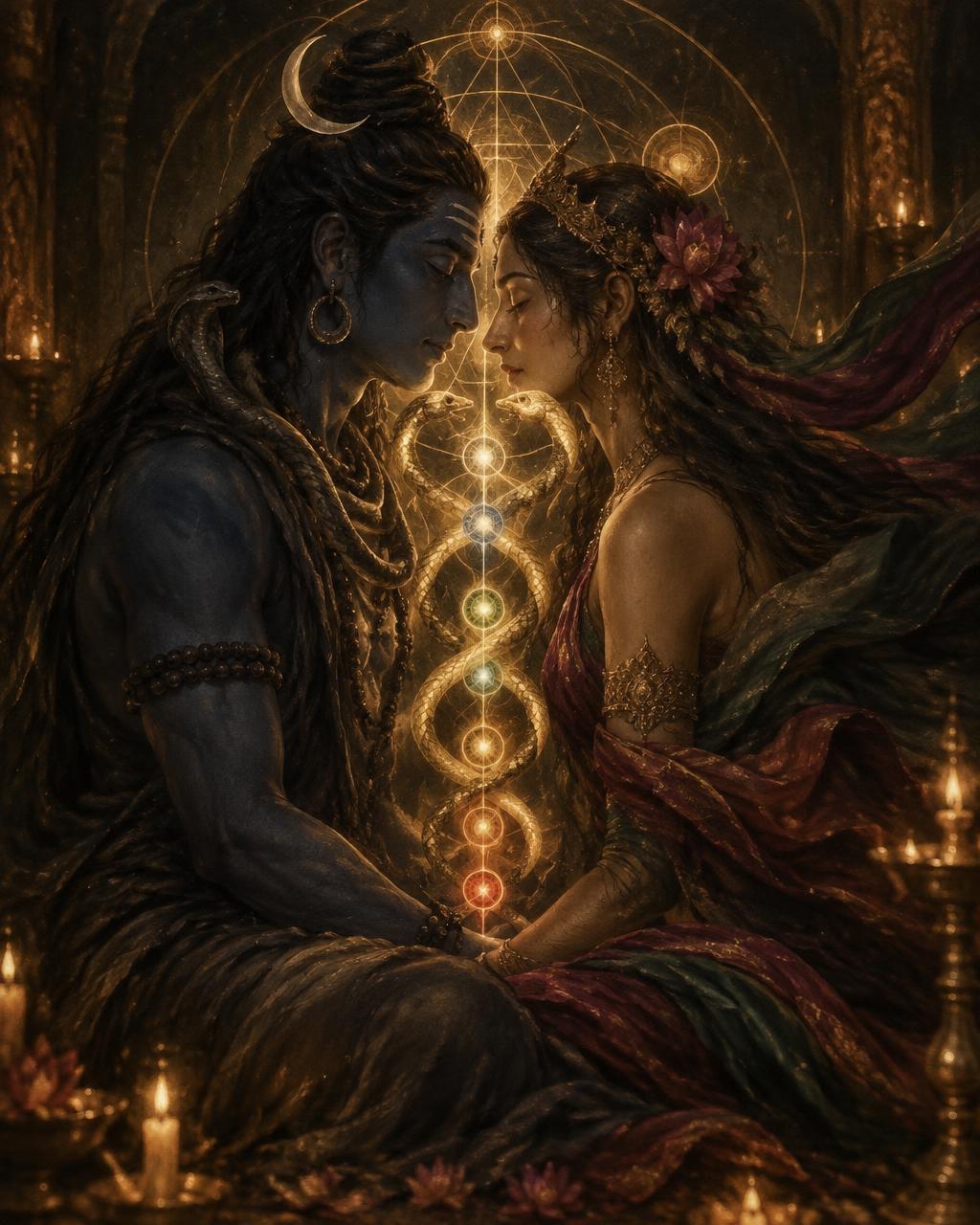
Not long ago, the phrases divine feminine and divine masculine belonged mostly to retreats, workshops and spiritual books. Now I hear them in conversations about relationships, on podcasts, across social media and occasionally in places I would never have expected.
I cannot tell you that there has been a measured cultural resurgence. I have not seen evidence that would let me say that honestly. What I can say is that the ideas feel more visible, and that their visibility brings both a beautiful opportunity and a fair amount of confusion.
A moment on television
Watching the second series of The Gentlemen on Netflix, I was struck by a scene in the second episode, There's a Rat in the Kitchen. Standing in a cathedral, the character Stanley Johnston, played by Giancarlo Esposito, explains to Eddie Horniman why a monarch holds an orb and a sceptre at a coronation. As the episode transcript records it: "The spire and the scepter represent the masculine, the orb, the feminine." A moment later he adds: "The crown represents the conscious reconciliation of these two opposing forces."
It is a crime drama, and Johnston is hardly a spiritual teacher. He uses the idea in the service of power. Yet the image itself, two complementary forces brought into conscious union, is very old, and it is close to something I recognise in Tantra.
Shiva and Shakti
In some Tantric traditions, Shiva represents consciousness, stillness and awareness, while Shakti represents the creative movement of life, energy and expression. Neither is complete without the other. Shiva without Shakti is awareness with nothing to be aware of. Shakti without Shiva is movement with nobody present to experience it.
This is the first place where modern conversations can go astray. The divine feminine and divine masculine are not descriptions of women and men. They are not instructions for how women or men should behave. They are qualities of existence that can be experienced within every one of us, whatever our gender.
Yin and yang: a parallel, not the same thing
People often reach for the yin and yang symbol when they talk about this, and I understand why. Within Chinese philosophy, yin and yang describe interdependent qualities, each containing a seed of the other, each giving rise to the other. It is a beautiful parallel. It is also a different tradition, with its own history and its own meaning, and I think it deserves to be respected as such rather than folded into Tantra.
Two serpents and a central channel
In yogic and Tantric imagery, Ida and Pingala are subtle energy channels often associated with lunar and solar qualities. They are sometimes shown as two serpents winding around Sushumna, the central channel associated with the chakras. The picture expresses complementary forces meeting and coming into balance.
I offer this as spiritual symbolism. These channels are not physical anatomy, and the imagery is not medical science. Its value, for me, is in what it invites us to notice within ourselves.
Why these ideas may be speaking to people now
I can only offer my own sense of it. Many of us live almost entirely in one mode: doing, achieving, planning, pushing forward. There is often very little room for stillness, and very little room for simply feeling. Perhaps the language of feminine and masculine energies gives people a way of naming that imbalance.
The risk is that the language becomes another set of expectations. Be more feminine. Be more masculine. Find the partner who will complete you. That is not how I understand Tantra at all.
What it means in my practice
For me, the relationship between Shiva and Shakti is something to experience rather than perform. In meditation and conscious breathing we can notice both: the stillness that watches, and the life that moves through the body as sensation, breath and feeling. Over time, they can come into greater harmony.
It is not about looking outside ourselves for somebody to complete us. It is about recognising the qualities that are already here.
You can't create yourself; you already are yourself.
If you would like to explore this through experience rather than reading, Spiritual Tantra is perhaps the most direct place to begin, and Neo Tantra Massage brings the same awareness into full body touch. I am always happy to talk through which might suit you.